Mostrando entradas con la etiqueta eTwinning. Mostrar todas las entradas

viernes, 26 de mayo de 2017

El año de la revolución eTwinning

Había una vez una joven profe que dio con un curso sobre conciencia europea y eTwinning. Era yo hace unos años. Pensé que era un curso tan interesante y motivador que quería llevarlo a mi aula... pero nunca llegó a ocurrir.

Al principio de este curso volví a la plataforma eTwinning, decidida a hacer algo más que buscar y revisar cosillas. Quería interactuar, participar de todas las maneras posibles. Y no me tomó mucho tiempo: a los dos días ya me había unido a mi primer proyecto eTwinning: Butterflies across Europe.

Mis alumnos estaban verdaderamente entusiasmados; las familias, curiosas y contentas con esta iniciativa, y mis propios compañeros decían que era una actividad bonita, alegre e interesante. Los niños escribieron y leyeron mensajes de sus compañeros europeos, todos en inglés, demostrando su interés y habilidad en este idioma, e incluso usaban el mapa para situar los países de los colegios cuyas cartas recibíamos, relacionándolos con otros personajes y monumentos famosos.

Después de este exitazo, quería continuar la aventura, probar más proyectos, encontrar experiencias emocionantes que llevar a la clase. ¿Lo adivinas? ¡Sí, me uní a otro proyecto! Esta vez el tema eran los 6 sombreros para pensar. Ahora mismo estamos aún trabajando en ello, dándonos cuenta de cómo vamos mejorando y descubriendo que quizá no era tan difícil como inicialmente había pensado. ¡Mis alumnos no paran de sorprenderme!


¡Pronto os contaré más sobre el proyecto de los seis sombreros!

jueves, 25 de mayo de 2017

Project plan for a new eTwinning adventure!

Here is it, finally! The challenge for unit 5 of the MOOC "Open eTwinning" was designing a complete plan for the draft I already shared on a previous entry. I've just finished the task, and I must say it has really put my brain to work, but I'm a lot more satisfied than tired -and that's a lot!

Have a look at this emaze presentation and feel free to leave your comments and suggestions.


Powered by emaze

miércoles, 17 de mayo de 2017

Revising my draft

The tasks for unit 3 include designing a project draft and our first P2P activity, assessing each others' drafts. It's been a really interesting unit because of all these opportunities to do and reflect about work about work (my own and my partners'). It's been really enrichening to assess peers' drafts because it forces me to think about the good and not-so-good (there is no bad!) parts of it, as well as the more suitable words to express your opinion or advice to that partner.

Considering the strengths of the projects in the MOOC, the main positive point I've seen is the will to learn of all the participants -keep going despite the many hours of school, and a very positive attitude to realize necessities and change what is needed in order to achieve a better result. Creativity is remarkable, and reflection, obviously, because every information has been considered carefully (even if this was just a draft, it's the beginning of a good plan).

Within my own project, peers' assessments and my own were quite similar. The aspects that gathered more positive comments were:

   - The topic itself: everyone understands food, can have an opinion about it and have different experiences (eat, buy, cook, like, dislike, traditions related to food...). It's a good start to work on in the different subjects.

    - The objectives: perhaps I should have reduced the list, but I thought those objectives can be split among the different subjects (Natural Science, Literacy, Maths, English), making easier their evaluation as each subject would have no more than 3 of them.

    - The final results: they are attractive, easy to understand and enjoy by everyone.

On the other side, there are the weaknesses:

    - Number of partners/students per group: it's not clearly defined. I found it hard to be specific about this point because... how can I do it if I don't know yet how many schools will be interested in the project? Perhaps if I get one more partner we can discuss this part and make a decission about how many other partners to find.

    - Communication among students: I have some doubts about it. My pupils are 6-7 years old and I think they might have some difficulties writing messages in English to other European partners. Besides, when we use ICT tools or apps in class, it's something a lot more simple, not like chatting, discussing and make decisions in a foreign language, so I got a bit lost about this part.  I will find a way to make communication and collaboration in this project real. 


One of the peers that assessed my draft mentioned it would be a good idea to involve families in the project. I didn't make it clear enough, but they were in my mind too: from helping children get to know the recipes they cook at home to the final result of the gastro-fair, which can be a great family activity: cook at home, try different ingredients and dishes and share the results with the rest of the community! 


Finally,  I think this task of assessing several projects will really help the final version of my draft. After reading several projects, realizing there are several common points in our drafts, and considering the revisions of my own work (both by my peers and myself) I can look at my draft in a somewhat different way from when I was writing it and be a bit more critical. I still think some aspects should be discussed once I got partners, but I'm sure I'll make some corrections.


Thank you everyone for your comments and for helping me improve my project!

sábado, 13 de mayo de 2017

Open eTwinning. Unit 2. Conclusions

In unit 2 we were asked to reflect on those aspects of our teaching we need to improve and learn about. Afterwards, we had to search for some projects that could help with it. And well... I was overwhelmed with so many ideas!

First, about those things I need to improve I would say the feeling of being stuck. Sometimes I feel we have too many contents and/or too little time to teach, plus all the extra activities, and other events in the class (some problem happened that morning, children not understanding something and taking more time than expected, etc) put pressure on us, like we're on a hurry. In those moments, it's easy to feel overcome and feeling you lose control of your own work and tasks. 

Another aspect I need to improve is the use of ICT tools more regularly, and relying on children to make an autonomous, good use of them. So far, when I include some technology in the class, it's still me using the keyboard and mouse, leading all the task and giving children a very little responsability. 

About the lack of autonomy, perhaps it's because the age of my group of children (6-7 years old). I know they are digital natives and their knowledge (from playing games and videos on the computer, tablet or smartphone at home) and intuition will make up for the lack of practice of this or that concrete application I want to use in class. But at the same time, they're children and I don't want them to accidentally drop the tablet or find some problem with the settings. To avoid this, so far, we've used only one tablet per team. 

I should also be more regular and include some time for ICT activities along the week, either in Maths lessons, Literacy, Social Science... It's also a bit related to the paragraph above: it's already May and we still need to teach quite a few contents, complete the books, evaluations... So, I need to take a breath, think of this as one more part of the curriculum and make a plan.

Apart from all that, we need to develop and evaluate competencies, however I (we?) still spend quite a lot of time on mechanical tasks and tests to practice and repeat contents, but not applying them on a real situation of childrens' lives. 

What did I learn from the projects?  
I browsed the SNA website and read about a few projects whose titles caught my attention. It was like opening a chest full of creativity and bright ideas. I suppose with all these new treasures and the feedback from the MOOC participants I realized we all have similar doubts, but we do also have the enthusiasm and the will to learn more and improve so...

...What to do when I feel stuck? 
Relax and take a deep breath. You've been through this before. Keep calm and make your plan considering less is more: hurry will make us chaotic and us, teachers can't afford that. Quality before quantity. Checking projects from other teachers will also provide some ideas about activities to make our lessons more effective.

...What ICT tools can I use and when? 
So far, Plickers got a great success and children even ask for it, but it's not one tool in which children have a main role using ICT devices. I have to return to my idea at the beginning of the school year to use Padlet: every child can write a post with their answer to an open question. About the 'when', the last period of the day is a bit more complicated. Children are more tired and sometimes even start to bother other students, so it might be a good moment to use such motivating tools and activities.

These are my top apps for the class

In case we can participante on a eTwinning project, the TwinSpace offers tools for communication among teachers and students too. 

...How can I work on and evaluate competencies? 
Projects are competencial tasks by defnition. Every teacher can create their own project, adapted to the characteristics of their own group, school and city, so the curriculum will be perfectly integrated and the project will be related and adapted to students' real life situations. We can even give children the chance to try actions and experiences they wouldn't normally do... but will surely enjoy, like for example, interviewing someone, participating on a radio program, etc. 

Of course I need to use books and do some mechanical tasks in order to practice contents... but children will learn a lot more with activities that develop their competences, like projects. These will also stimulate their motivation and enthusiasm, which is exactly what neuroscience states: we learn what excites us. 

Possibly, I could pass children a test after the project, to check what they've learnt, but that wouldn't evaluate competencies unless I suggested similar situations to those studied along the project. Plickers, Quizziz or Kahoot could lend a hand too. But it would be easier to use rubrics, learning diaries, self-assessment and peer assessment to evaluate students' competencies along the project. 


lunes, 8 de mayo de 2017

Project draft


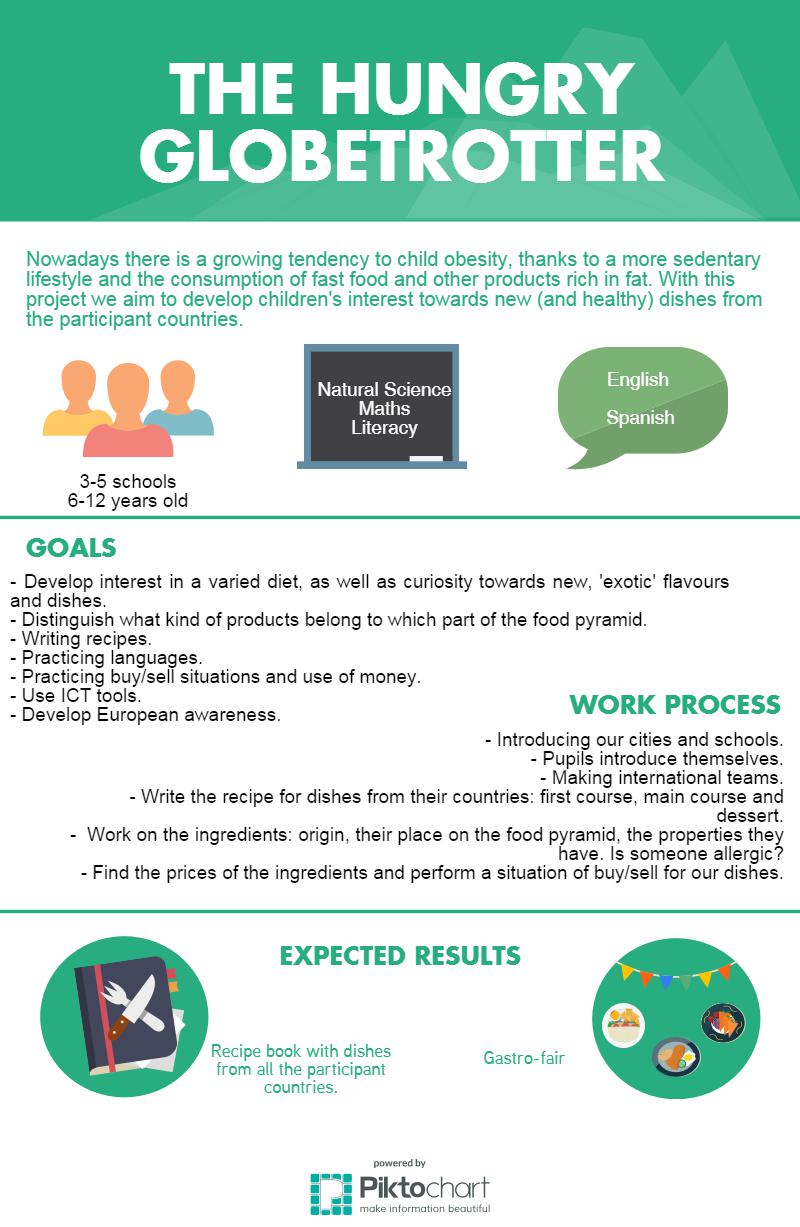
Here is the project draft for the Open eTwinning MOOC. Food as the main topic of the project because, after all, we all need to it, have favourite dishes and need to get (or improve) healthy habits.

From there, we shall do several activities working on different food and dishes and everything would result in a book with all our recipes... and the possibility of celebrating a fair with those different dishes.


Feel free to leave some comments, they will help me learn!


Getting inspired

Today I'm trying to get some ideas in order to re-design and modify my next draft for a collaborative project. Sometimes I have an idea, maybe not very clear on how to be carried out, but I can picture some scenes in my mind about some parts of the work... and when this happens, it's difficult for me to think outside that box. 

So here I am, browsing the net in search for some successful projects, in order to fill the gaps in my own draft. By reading about these amazing experiences I feel there is a great challenge ahead, and I'm just a beginner... 

However they are perfect examples of where collaboration can lead to. There is a lot to learn about international teams, use of varied ICT tools, interaction among schools and really colourful, fascinating final results. Surely we'll find difficulties when working on our own project, but with the help of our partners, and all the information and experiences other teachers share, we can make our own ideas shine! Aaah... if we can learn (and, with our example, make our pupils learn) the importance of collaboration!! 

I leave you to the eTwinning National Support Service website, where you can select projects by age, subjects, school or awards won: Handmade Christmas exchange, La marmita fantástica, El laberinto de las palabras, Our School Anti-Bullying Campaign – Respect, etc.

sábado, 6 de mayo de 2017

Top apps for the class!


Today I want to share with you a list with some apps I've tried in my classroom. Most of them are very easy and children can use them with few indications, and definitely all of them are colourful and motivating. Go have a look and, if you feel like it, leave some comments with your own suggestions and opinions.


Top apps for the class list

I hope you like it!

jueves, 4 de mayo de 2017

eTwinning in 140... or a bit more

A while ago I had to describe on Twitter what eTwinning is to me. To be honest, 140 characters is not much, but it helps being concrete, go to the core idea and avoid unnecessary ornaments. This is my tweet:

"eTwinning is a unique opportunity to release creativity, test skills, enjoy with colleagues with same interests and needs. Try it!"

Let's make this short X-ray grow a little bit. In my recent experience on eTwinning, I've taken part with other teachers on a project consisting on a handcrafts exchange by mail and testing our English skills. This project was not included in our curriculum, but I thought it could be a nice experience for my 6 year-old children... and it surpassed my expectations greatly!! 

Kids were absolutely enthusiastic about the project, elaborating the most wonderful handcrafts and feeling eager to hear from their European peers. Can you imagine a better way to practice those initial dialogues in English? "My name is... I'm ... years old. I like... I don't like..." They could read and understand perfectly each message in a real situation (the post exchange with other schools). Motivation was so high they wanted to check the map whenever we got some new envelopes with the mail and even learn a bit more about those countries so far. 

Along this process, I've also taken part on online activities in which ICT tools were a key point. Not only they facilitate collaboration between partners that are quite far from each other, but they're also very attractive, and most of them, very easy to use... It got quite addictive! 

So we have, motivation, real practice of language skills and ICT. What can we do with these ingredients? Again, a new project! For a while now, trends in education talk, among others, about the flipped classroom and project based learning (PBL). I think it's easy to engage the class when you offer them a topic of their interest, and give them the main role on their learning process, let them search, investigate, reflect, do. Show them the new ICT tools, and they'll be asking for more. 

One final point. Experiencing eTwinning enriches yourself both in a personal and professional way, but it also reaches your students -obviously- and your colleagues: those who weren't part of your project might soon want to join when they see the results by themselves. Enthusiasm spreads fast!! The school will benefit from it too: professionals with experience in collaborative projects with other European schools, the possibility to be awarded with national and European quality awards, and the chance to develop practices that combine innovation, ICT, languages, and PBL. 

I'm not sure if I expressed myself clearly enough... why don't you check the site by yourself? 

Gamificación: básicos (muy básicos) y algunas reflexiones

No hace mucho hemos tenido una nueva sesión de formación, en este caso, sobre gamificación . Aparte de recordar algunos conceptos básicos...